A customer list is not the whole CRM
Two briefs can both say “contacts, pipeline and reporting” and describe very different projects. One team needs a shared sales view. Another needs branch-specific access, quote approval, job scheduling, invoice status and an audit trail. Counting screens will not reveal that difference.
For a London consultancy or UK service operator, separate the sales record from the delivery process. Does a won deal create a project? Can one organisation have multiple billing contacts? Who approves a discount? Each answer changes the model, validation and test work.
This guide deliberately avoids presenting an unsupported market price as an agency quote. It gives you a scoping method and an illustrative calculation so competing proposals can be compared on the same basis.
Ask for these work packages in every proposal
A useful proposal names what is delivered, what is assumed and how acceptance is decided. “CRM integration included” is too vague if nobody has checked the API, rate limits, historical data or failure handling.
Ask for migration rehearsal, access testing, operator training and handover as explicit work packages. If they are omitted, the headline build price cannot tell you what reaching a usable launch will cost.
| Work package | What changes the effort | Evidence to request |
|---|---|---|
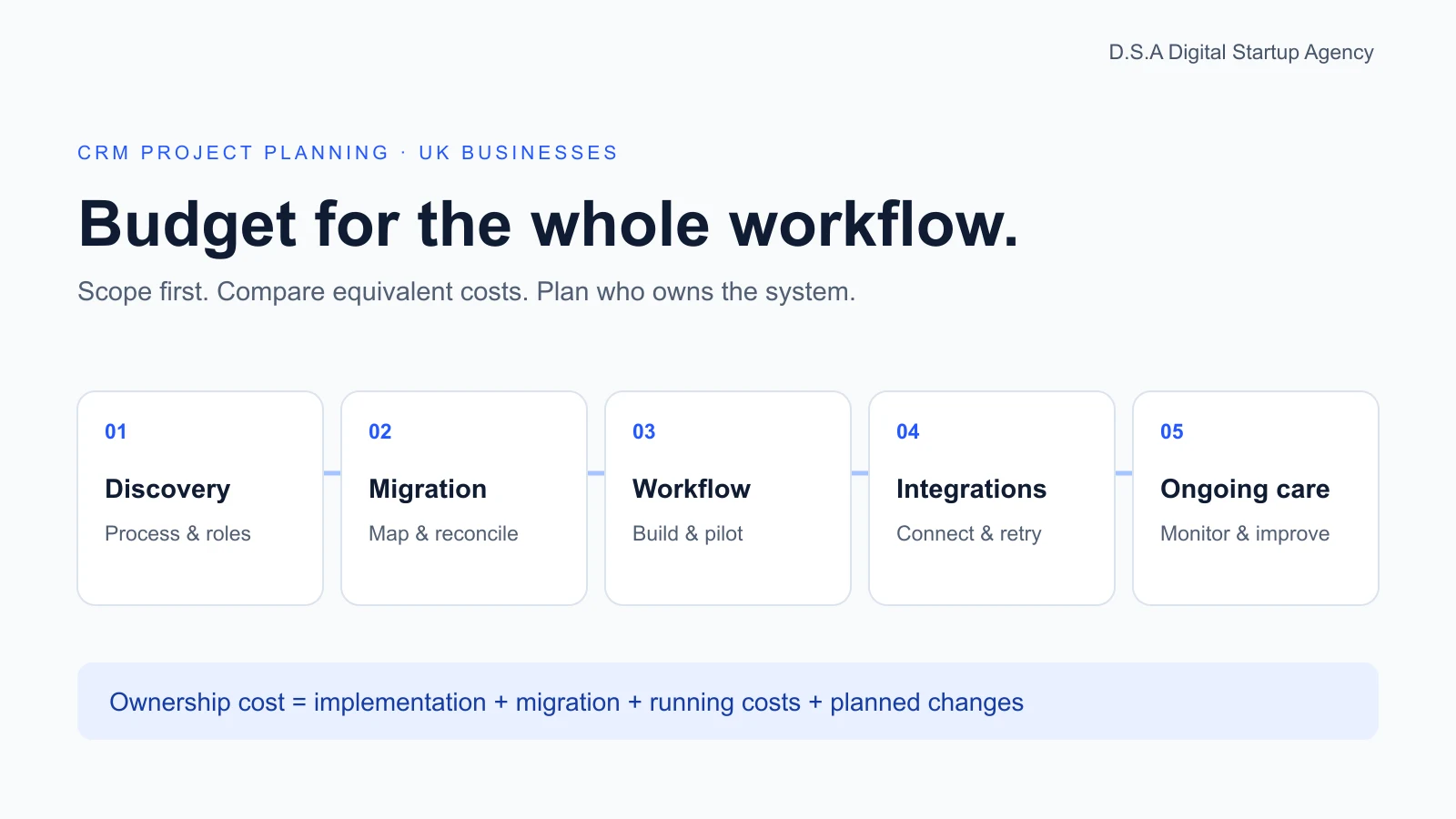
| Discovery and scope | Number of workflows and decision owners | Process map and acceptance criteria |
| Data model and permissions | Relationships, teams and access boundaries | Role matrix and example records |
| Migration | Dirty data, history and attachments | Mapping sheet and reconciliation plan |
| Integrations | API quality, retries and two-way updates | Failure handling and ownership rules |
| Rollout | Training, pilot users and cutover | Pilot findings and launch checklist |
| Ongoing care | Support response and update responsibilities | Written maintenance and recovery scope |
Compare configuration, extension and custom development
Configure an existing CRM when contacts, opportunities, tasks and standard automation fit the job. Extend a CRM when its core model works but one integration or specialist workflow needs custom code. Consider a custom application when the operating process cannot be represented without fragile workarounds.
Do not compare a CRM subscription with development alone. Compare equivalent capabilities across the same period, including setup, migration, paid seats, add-ons, integrations, support and internal administration.
Neither route removes maintenance. An existing platform needs configuration ownership and integration support; a custom application needs security updates, monitoring and a named technical owner.
Use a transparent three-year ownership calculation
Use this formula: initial implementation + migration and training + 36 × monthly platform and support costs + planned change budget. For subscriptions, include seat growth and paid features. For custom systems, include hosting, third-party usage and maintenance. Include taxes consistently in both options.
Illustrative example only, not a Digital Startup Agency quote: £12,000 implementation + £3,000 migration and training + (36 × £250 ongoing costs) + £6,000 planned changes = £30,000 over three years. Replace every input with a scoped quote. The £250 figure is a fictional combined monthly allowance, not a hosting or support offer.
Calculate staff time separately so it does not masquerade as guaranteed cash savings. If 5 staff each avoid 20 minutes of repeated entry on 20 working days, that is about 33.3 hours per month. At an assumed £25 per hour, it represents roughly £833 of time capacity, only if a pilot demonstrates that saving. It does not mean payroll falls by £833.
| Illustrative input | Calculation | Three-year amount |
|---|---|---|
| Implementation | Assumed one-off input | £12,000 |
| Migration and training | Assumed one-off input | £3,000 |
| Ongoing costs | 36 × £250 | £9,000 |
| Planned changes | Assumed allowance | £6,000 |
| Total | 12,000 + 3,000 + 9,000 + 6,000 | £30,000 |
Reduce scope around one measurable workflow
A smaller useful release might capture an enquiry, assign an owner, create a follow-up task and show whether it is overdue. Keep permissions, recovery and audit decisions in scope. Defer dashboards and secondary workflows that do not change that outcome.
Measure median first-response time, the share of open leads with an owner, and the share with a dated next action before launch. Define the same measures for the pilot. A dashboard showing more records is not evidence that the team is doing less repeated work.
Agree ownership of source code, infrastructure accounts, customer exports and integration credentials in the contract. Ask how another developer would take over. The answer should include documentation, deployment instructions, data exports and recovery procedures.
Include UK data handling in the brief
For UK customer records, discuss role access, retention, deletion, processor responsibilities and hosting arrangements during scope. The ICO’s small-organisation guidance describes privacy as a design consideration throughout a system’s life, rather than a final feature toggle.
A UK business does not automatically need every system to run in one UK data centre, and a hosting location alone is not proof of compliance. Document the actual processing and any transfers with the responsible adviser rather than relying on a generic “GDPR compliant” badge.
Bring these inputs to a scoping conversation
Prepare a redacted sample of your fields, a list of tools that must connect, your user roles, and one example of an enquiry from arrival to completion. Describe what goes wrong today and what a successful first release would let staff do differently.
Ask the supplier to distinguish fixed scope from assumptions and separately priced changes. Request acceptance criteria for permissions, imports, integrations and recovery. Agree the launch support period and how future changes are estimated.
Digital Startup Agency can review that brief and discuss whether configuration, integration work or a custom build is the sensible next step. A recommendation should follow the workflow review, not precede it.
Frequently Asked Questions
Common Questions & Engineering Trade-offs
How much does a custom CRM cost in the UK?
There is no reliable single price without scope. Ask for discovery, implementation, migration, integrations, training and ongoing support to be priced separately. The worked example here is illustrative, not a quote or market average.
Is a custom CRM cheaper than an off-the-shelf CRM?
It depends on the process, seat count, integrations and maintenance responsibilities. Compare equivalent capabilities over the same ownership period rather than comparing a subscription price with a build estimate.
What ongoing costs should I budget for?
Consider hosting, email or messaging usage, backups, monitoring, security updates, integration maintenance, staff support and planned product changes. Confirm which responsibilities are included in each proposal.
Can we build the CRM in phases?
Yes, if each phase is useful on its own. Start with one complete workflow and its essential data, permissions and recovery requirements, then use pilot evidence to prioritise the next release.
Related Blueprints
Explore Related Technical Playbooks
Spreadsheet to CRM Migration: A UK Business Checklist
Read blueprint →Operations & CRM SystemsReplacing Spreadsheets with Custom CRM & Business Operating Systems: The High-Growth Playbook
Read blueprint →Customer & Business PortalsBuilding Secure B2B Client Portals: How to Eliminate 80% of Support Overhead
Read blueprint →Get a scope you can compare.
Tell us which workflow is slowing the team down. We will review the process, integrations and first-release priorities before discussing a build.